The choice of pen determines not only how writing looks on the page but also how quickly it dries, whether it smudges under a left-handed grip, and whether it functions correctly at low temperatures. For professionals and students who write frequently by hand, these differences are material rather than cosmetic.
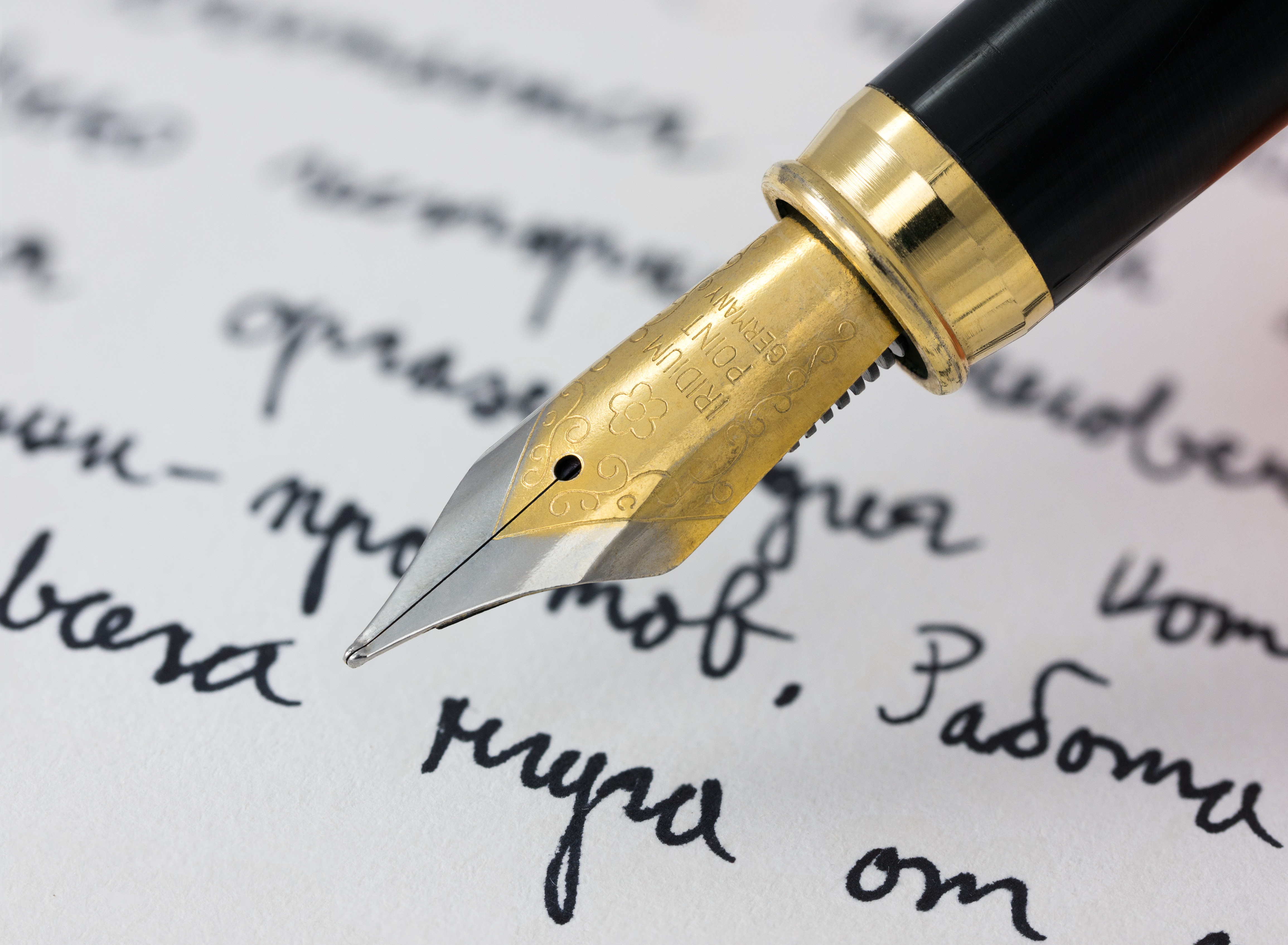
Fountain pen writing — Wikimedia Commons, CC BY-SA
The Three Main Categories
Writing pens sold in Poland fall into three primary categories defined by their ink delivery mechanism. Each has specific performance characteristics that make it better suited to certain tasks.
Ballpoint Pens (Długopisy kulkowe)
A ballpoint pen uses a small rotating ball at the tip to transfer oil-based ink from an internal reservoir to the paper. The ink is thick and slow-drying relative to air exposure, but dries almost immediately on contact with paper because it bonds to the surface rather than absorbing into it.
Key characteristics:
- Ink does not bleed through most paper weights, including 70–80 g/m²
- Does not require air-tight storage — the ink reservoir is sealed against evaporation
- Functions at low temperatures (relevant for outdoor use in Polish winters)
- Smear-resistant immediately after writing
- Requires more pressure to write than gel or fountain pens, which can cause hand fatigue over long writing sessions
Ballpoint pens are the dominant format in Polish offices and educational settings. Brands such as BIC, Pentel, and local distributors supply ballpoints in quantities for institutional purchasing. The BIC Cristal, a globally produced pen, is among the most widely distributed writing instruments in Poland.
Rollerball and Gel Pens (Długopisy żelowe / Rollerball)
Rollerball pens use the same ball-tip mechanism as ballpoints but with water-based ink. Gel pens use a pigment suspended in a gel medium. Both deliver ink more freely than oil-based ballpoints, producing a more fluid, consistent line with less applied pressure.
Key characteristics:
- Significantly lower writing friction — suitable for long handwriting sessions
- Water-based inks absorb into paper rather than sitting on top; more likely to bleed through lightweight paper
- Dry time is longer than ballpoint on coated or glossy surfaces
- Gel ink can smear if touched immediately after writing, particularly problematic for left-handed writers
- Line width is more consistent and the ink colour is typically more saturated than ballpoint
Gel pens from Pilot (G-TEC-C, Juice series), Pentel (EnerGel), and Uni-ball (Signo) are available through Polish office supply retailers and Empik. These are commonly used for personal note-taking where clarity of line is prioritised over smear resistance.
For left-handed writers, ballpoint pens with faster-drying ink are generally preferable to gel or rollerball. The hand drags across fresh writing, and oil-based ink dries sufficiently fast on contact with paper to avoid smearing under the heel of the hand.
Fountain Pens (Wieczne pióra)
Fountain pens use a nib — a split metal point — to deposit liquid ink on the page. Ink flows from a cartridge or converter reservoir through a feed system to the nib, where capillary action transfers it to the paper. The nib glides across the surface rather than pressing into it, requiring minimal pressure.
Key characteristics:
- The lowest writing friction of any pen type — suitable for very long writing sessions
- Nib width (Extra Fine to Broad) affects both line width and ink flow volume
- Requires paper with low absorbency (smooth, well-calendered surface) to avoid feathering
- Not suitable for forms with carbon copy paper, as the light nib pressure does not transfer
- Ink takes longer to dry than ballpoint, particularly with wet nibs or on coated paper
Nib Widths and Their Practical Effect
Fountain pen nib designations — EF (Extra Fine), F (Fine), M (Medium), B (Broad) — are not standardised across manufacturers. A Fine nib from a Japanese manufacturer (Pilot, Sailor, Platinum) writes considerably narrower than a Fine from a German manufacturer (Lamy, Pelikan, Kaweco) or a French one (Waterman, J. Herbin).
| Nib Width | Approximate Line (Japanese) | Approximate Line (European) | Use Case |
|---|---|---|---|
| Extra Fine (EF) | ~0.3 mm | ~0.5 mm | Small handwriting, dense notes |
| Fine (F) | ~0.4 mm | ~0.6 mm | Standard note-taking |
| Medium (M) | ~0.5 mm | ~0.8 mm | General writing, journals |
| Broad (B) | ~0.7 mm | ~1.0 mm+ | Signatures, headings, expressive writing |
Ink Cartridges vs. Converters
Fountain pens accept either proprietary ink cartridges or a converter — a refillable reservoir that allows the use of bottled ink. Converters are available for most major fountain pen brands and expand the range of available inks substantially. Bottled inks in Poland are available through Empik (limited selection) and specialist online retailers.
For institutional or occasional use, cartridges are more practical. For regular fountain pen users, a converter and bottled ink is more economical and offers more colour variety.
Pencils as an Alternative
Pencils remain relevant in certain professional contexts: architectural drawing, examination drafts, and any application where erasability is required. Standard HB pencils are the universal default in Polish schools. Harder grades (H, 2H) are used for technical drawing; softer grades (B, 2B) for sketching and artistic work.
Mechanical pencils (ołówki mechaniczne) with 0.5 mm or 0.7 mm leads are common among engineering and architecture students. They maintain a consistent line width without sharpening and are available from Staedtler, Rotring, and Pentel at major Polish retailers.
Selecting for Specific Use Cases
Extended Note-Taking
For multi-hour lecture or meeting notes, a low-friction pen reduces hand fatigue. Gel pens and fountain pens with Fine nibs are preferable to ballpoints for this purpose. The paper should be smooth enough to minimise resistance — 80 g/m² or above with a surface smooth enough not to catch the nib.
Document Signing
Signing legal and official documents typically calls for a pen that produces a clear, permanent mark and does not bleed through the paper. Blue or black ballpoint or gel ink is conventional in Polish administrative and business contexts. Fountain pen ink is archival-quality and permanent when dry, but care should be taken that the ink has fully dried before the document is handled.
Shared Office Environments
In shared environments where pens circulate between users, ballpoints are practical: they do not require priming, do not dry out if left uncapped briefly, and function across a wide range of paper types. For personal use at a fixed desk, a gel or fountain pen offers a more comfortable writing experience.
Last updated: June 2026